
Listen
Watch
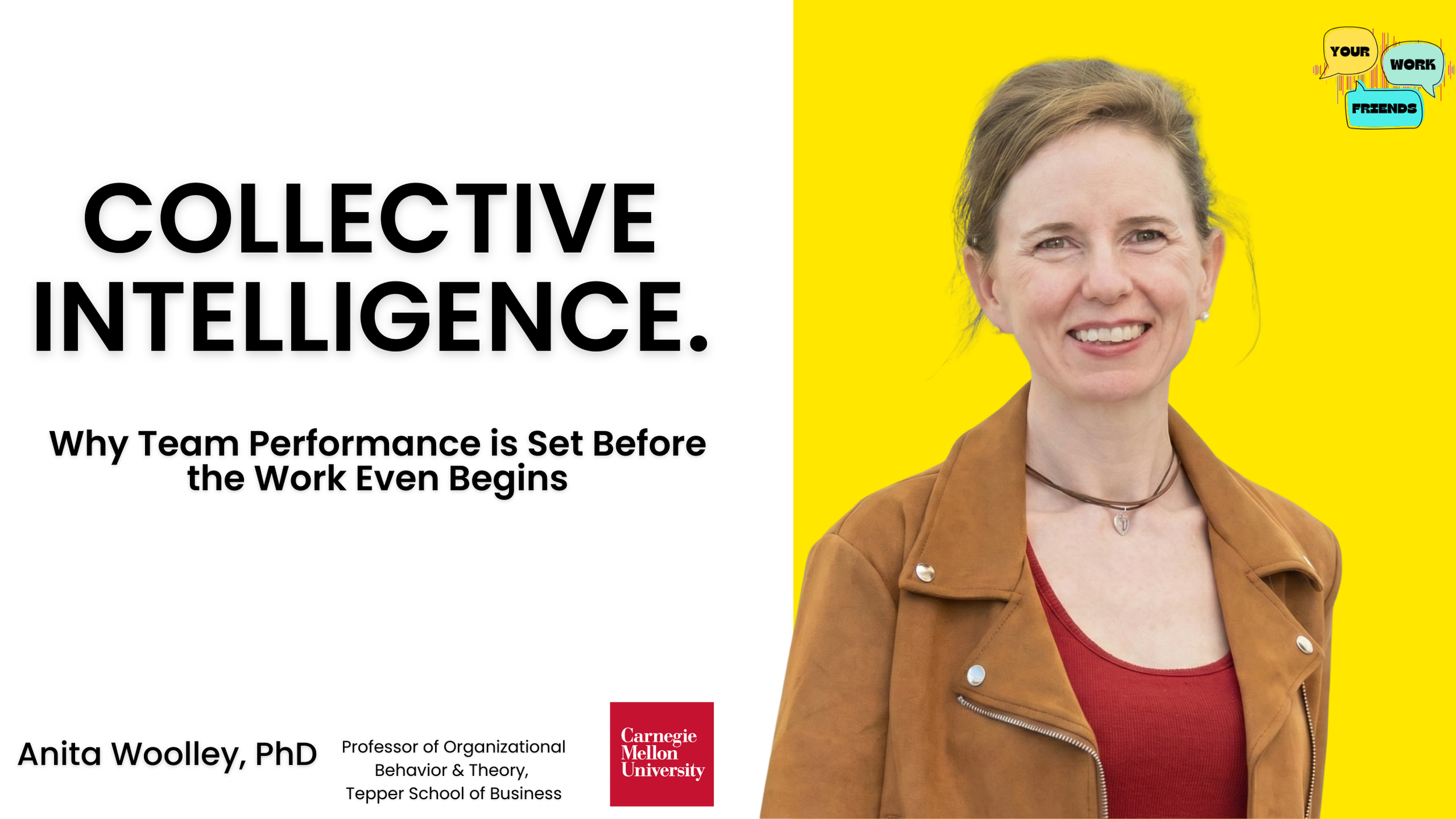
Smart people don’t automatically make a smart team. In this episode, Carnegie Mellon Tepper School of Business Professor of Organizational Behavior & Theory, Anita Williams Woolley, PhD, breaks down what “collective intelligence” really is, why team performance is mostly set before the work even begins, and what leaders can change this week to improve how teams coordinate—especially in remote/hybrid environments.
We also dig into AI agents as teammates: when AI reduces collaboration, and when it can actually make teams more human, connected, and effective.
INTELLIGENCE IS COLLECTIVE…
Smart people do not automatically make a smart team.
In this episode of Your Work Friends, we sit down with Anita Woolley, PhD, Carnegie Mellon professor and one of the leading researchers on collective intelligence (aka team intelligence). We break down why team performance is often decided before the work even begins, what “stage setting” leadership actually looks like, and the practical behaviors that separate teams that move from teams that meet.
We also go straight at the messy reality of remote work and hybrid work: meeting overload, unequal participation on Zoom, async chaos, and why “digital-first” is not optional anymore. Then we get into the next wave: AI agents as teammates. Anita shares a simple but powerful distinction: using AI for production vs using AI for coordination, and why that choice can either shrink collaboration or make teams more connected and effective.
What we cover:
What collective intelligence is and how it differs from individual IQ
The “people, goals, coordination” checklist for building better teams
Why equal talking time is one of the clearest signals of a smarter team
Social perceptiveness, team composition, and what leaders can do if their team lacks it
“Synchrony” vs “bursts”: how high-performing teams coordinate in-person and async
The 60-30-10 rule of leadership: stage setting beats charisma (by a lot)
Remote and hybrid leadership mistakes, plus 3 tiny fixes you can make this week
AI agents at work: collective memory, expertise matching, psychological safety, and the risks
If you lead a team (or you’re stuck on one), this is the episode.
Listen for the practical resets you can try over the next 90 days to boost coordination, cut meeting drag, and get the best thinking out of the whole group.
About Professor Anita Woolley, PhD:
Anita Williams Woolley is a Professor of Organizational Behavior at Carnegie Mellon University’s Tepper School of Business. Dr. Woolley received her doctorate in organizational behavior from Harvard University, and her research includes seminal work on collective intelligence in teams, first published in Science in 2010. Her current work focuses on collective intelligence in human-computer collaboration, with projects funded by DARPA and the NSF focused on how AI enhances synchronous and asynchronous collaboration in distributed teams. Professor Woolley is a Senior Editor at Organization Science and a founding Associate Editor of Collective Intelligence.
Disclaimer: This podcast is for informational purposes only and should not be considered professional advice. We are not responsible for any losses, damages, or liabilities that may arise from the use of this podcast. The views expressed in this podcast may not be those of the host or the management.
Connect with Us
-

Mel Plett
CO- FOUNDER & CO-HOST
-

Francesca Ranieri
CO-FOUNDER & CO-HOST
-

Anita Woolley, PhD
Professor of Organizational Behavior & Theory, Carnegie Mellon University
Tepper School of Business